Fluoroquinolone efficacy against tuberculosis is driven by penetration into lesions and activity against resident bacterial populations

Submitted by kirschne on

Fluoroquinolones represent the pillar of multidrug-resistant tuberculosis (MDR-TB) treatment, with moxifloxacin, levofloxacin, or gatifloxacin being prescribed to MDR-TB patients. Recently, several clinical trials of “universal” drug regimens, aiming to treat drug-susceptible and drug-resistant TB, have included a fluoroquinolone. In the absence of clinical data comparing their side-by-side efficacies in controlled MDR-TB trials, a pharmacological rationale is needed to guide the selection of the most efficacious fluoroquinolone.

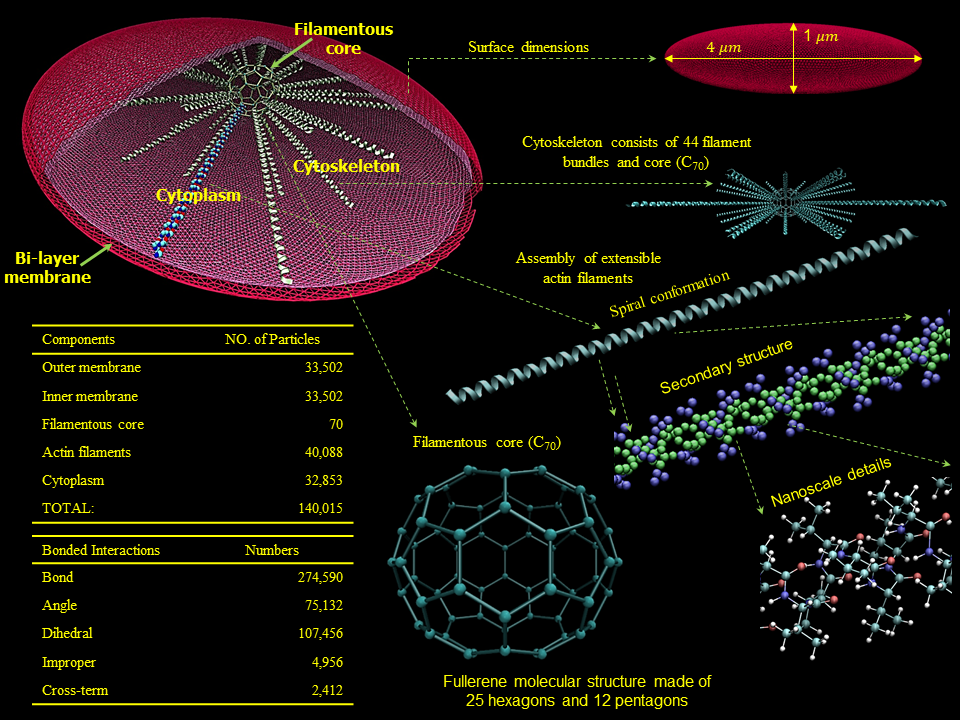
Multiscale Model of Platelet in Blood Flow

What is being modeled?
A deformable platelet model with active cystoskeletal components which can participate in flow-mediated activation, aggregation, and adhesion
Description & purpose of resource

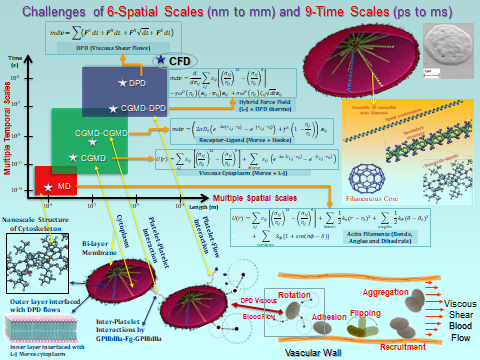
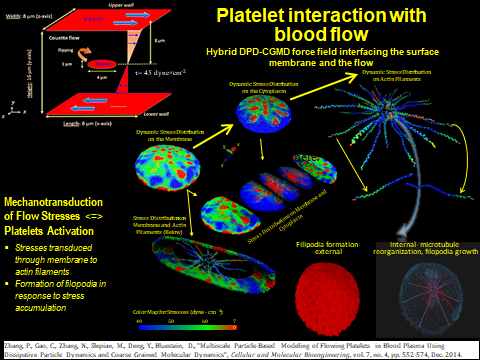
We will use an integrated Dissipative Particle Dynamics (DPD) and Coarse Grained Molecular Dynamics (CGMD) approach that allows platelets to continuously change their shape and synergistically activate by a biomechanical transductive linkage chain, interact with other blood constituents and clotting factors, aggregate, and interact and adhere to the blood vessels and devices. In this multiscale model, a mechanotransduction CGMD bottom platelet activation model is embedded into a DPD blood flow top model. The dynamic stresses of the macroscale model are interactively translated to the micro- to nanoscale model of the intra-platelet associated intracellular events. The model predictions are validated in vitro in a carefully designed set of experiments.

We have developed a mechanotransduction model of platelet mediated-thrombosis, where a top/macro-scale model of flow-induced thrombogenicity using DPD at the µm-length and ms-time scales, in which multiple flowing platelets interact with each other and blood vessel walls or devices, and is fully coupled with a bottom/micro-scale model using CGMD at the nm-length and ps-time scales, in which platelets with multiple intracellular constituents evolve during activation as platelet lose their quiescent discoid shape and filopodia grow. The top and bottom models are interfaced such that the hemodynamics interactively respond to platelet shape change upon activation and platelet aggregation, and allow a thrombus to form. The model includes intraplatelet constituents (filamentous actin and microtubular cytoskeleton, cytoplasm), bilayer plasma membrane, and GPIIb-IIIa and GPIbα receptors for interaction with fibrinogen and von Willebrand factor during aggregation and adhesion, respectively. The dynamics and morphologies of the platelet model have been carefully validated in vitro for their mechanical properties, and flow-mediated platelet activation and aggregation. The model is currently undergoing development and in vitro validation for adhesion. This model can also be used to evaluate the effect of modulating platelet mechanical properties via antiplatelet agents. These data will be used to fine tune the large number of model parameters involved in this multiscale simulation and for validating the model predictions.

Multiscale platelet structureMultiple Scales of Platelet ModelingPlatelet Interaction with Blood Flow

Video file
Video file
Spatial scales
molecular
cellular
Temporal scales
10-6 - 10-3 s
10-3 - 1 s
1 - 103 s
This resource is currently
mature and useful in ongoing research
a demonstration or a framework to be built upon (perhaps with a sample implementation)
Has this resource been validated?
Yes
How has the resource been validated?

All model aspects are validated in vitro in a series of carefully designed experiments characterizing the mechanical properties of platelets and using blood flow experiments where conditions leading to flow induced platelet activation will be replicated, as well as experiments where platelet-wall and platelet device interactions will be measured and where platelets will be pretreated with modulating agents. We use platelets obtained from consenting healthy adult volunteers under Stony Brook University and University of Arizona IRB-approved protocols. Validation involves tools such as dielectrophoresis-mediated electrodeformation to measure mechanical properties, cone-plate-Couette viscometry and microfluidics to induce platelet activation, aggregation, and adhesion, scanning electron microscopy (SEM) to evaluate morphological details of activated platelets, and high-resolution and high-framerate DIC microscopy to capture platelet morphological changes and dynamics under shear flow.

Can this resource be associated with other resources? (e.g.: modular models, linked tools and platforms)
No
Key publications (e.g. describing or using resource)

Gupta, P.; Zhang, P.; Sheriff, J.; Bluestein, D.; and Deng, Y. A Multiscale Model for Recruitment Aggregation of Platelets by Correlating with In Vitro Results. Cellular and Molecular Bioengineering, 12: 327-343. 2019. 

Zhang, P.; Zhang, L.; Slepian, M. J.; Deng, Y.; and Bluestein, D. A Multiscale Biomechanical Model of Platelets: Correlating with In-Vitro Results. Journal of Biomechanics, 50: 26–33. 2017. 

Gao, C.; Zhang, P.; Marom, G.; Deng, Y.; and Bluestein, D., Reducing the Effects of Compressibility in DPD-based Blood Flow Simulations through Severe Stenotic Microchannel, Journal of Computational Physics, vol. 335, pp. 812-827, 2017.

Zhang, P.; Zhang, N.; Gao, C.; Zhang, L.; Gao, Y.; Deng, Y.; and Bluestein, D., Scalability Test of Multiscale Fluid-Platelet Model for Three Top Supercomputers, Computer Physics Communications, vol. 204, pp. 132-140, 2016.

Zhang, P.; Zhang, N.; Deng, Y.; and Bluestein, D., A Multiple Time Stepping Algorithm for Efficient Multiscale Modeling of Platelets Flowing in Blood Plasma, Journal of Computational Physics, vol. 284, pp. 668-686, 2015.

Pothapragada, S.; Zhang, P.; Sheriff, J.; Livelli, M.; Slepian, M. J.; Deng, Y.; and Bluestein, D. A Phenomenological Particle-Based Platelet Model for Simulating Filopodia Formation During Early Activation. International Journal for Numerical Methods in Biomedical Engineering, vol. 31, no. 3, pp. 1-16. 2015.

Zhang, P.; Gao, C.; Zhang, N.; Slepian, M. J.; Deng, Y.; and Bluestein, D. Multiscale Particle-Based Modeling of Flowing Platelets in Blood Plasma Using Dissipative Particle Dynamics and Coarse Grained Molecular Dynamics. Cellular and Molecular Bioengineering, vol. 7, no. 4, pp. 552-574. 2014. 

Bluestein, D., Soares, J.S., Zhang, P., Gao, C., Pothapragada, S., Zhang, N., Slepian, M.J., Deng, Y., Multiscale Modeling of Flow Induced Thrombogenicity With Dissipative Particle Dynamics and Molecular Dynamics, Journal of Medical Devices, vol. 7, issue 4, pp. 024502-024503, 2014.

Zhang, N., Zhang, P., Kang, W., Bluestein, D., Deng, Y., Parameterizing the Morse potential for coarse-grained modeling of blood plasma, Journal of Computational Physics, vol. 257, Part A, pp. 726-736, 2014.

Collaborators
Danny Bluestein, Ph.D.
PI contact information
danny.bluestein@stonybrook.edu
Keywords
platelets
aggregation
activation
molecular dynamics
coarse-grained molecular dynamics
dissipative particle dynamics
adhesion
thrombosis
machine learning
deep learning
high performance computing
parallel computing
heterogeneous multicore and multi-GPU architecture
multiple time stepping
multiscale modeling
multiscale simulations
Table sorting checkbox
Off

Integrating Non-human Primate, Human, and Mathematical Studies to Determine the Influence of BCG Timing on H56 Vaccine Outcomes

Submitted by kirschne on

Tuberculosis (TB) is the leading cause of death by an infectious agent, and developing an effective vaccine is an important component of the WHO's EndTB Strategy. Non-human primate (NHP) models of vaccination are crucial to TB vaccine development and have informed design of subsequent human trials. However, challenges emerge when translating results from animal models to human applications, and connecting post-vaccination immunological measurements to infection outcomes. The H56:IC31 vaccine is a candidate currently in phase I/IIa trials.

Emergence and selection of isoniazid and rifampin resistance in tuberculosis granulomas

Submitted by kirschne on

Drug resistant tuberculosis is increasing world-wide. Resistance against isoniazid (INH), rifampicin (RIF), or both (multi-drug resistant TB, MDR-TB) is of particular concern, since INH and RIF form part of the standard regimen for TB disease. While it is known that suboptimal treatment can lead to resistance, it remains unclear how host immune responses and antibiotic dynamics within granulomas (sites of infection) affect emergence and selection of drug-resistant bacteria. We take a systems pharmacology approach to explore resistance dynamics within granulomas.

Deletion of TGF-β1 Increases Bacterial Clearance by Cytotoxic T Cells in a Tuberculosis Granuloma Model

Submitted by kirschne on

Mycobacterium tuberculosis is the pathogenic bacterium that causes tuberculosis (TB), one of the most lethal infectious diseases in the world. The only vaccine against TB is minimally protective, and multi-drug resistant TB necessitates new therapeutics to treat infection. Developing new therapies requires a better understanding of the complex host immune response to infection, including dissecting the processes leading to formation of granulomas, the dense cellular lesions associated with TB.

Comparing efficacies of moxifloxacin, levofloxacin and gatifloxacin in tuberculosis granulomas using a multi-scale systems pharmacology approach

Submitted by kirschne on

Granulomas are complex lung lesions that are the hallmark of tuberculosis (TB). Understanding antibiotic dynamics within lung granulomas will be vital to improving and shortening the long course of TB treatment. Three fluoroquinolones (FQs) are commonly prescribed as part of multi-drug resistant TB therapy: moxifloxacin (MXF), levofloxacin (LVX) or gatifloxacin (GFX). To date, insufficient data are available to support selection of one FQ over another, or to show that these drugs are clinically equivalent.