

Keynote
Biosketch:
Dr. Charlene E. Le Fauve, Ph.D., National Institutes of Health, Senior Advisor, Scientific Workforce Diversity
Biosketch:
Dr. Charlene E. Le Fauve, Ph.D., National Institutes of Health, Senior Advisor, Scientific Workforce Diversity
Magneto- and electro-encephalography (MEG/EEG) non-invasively record human brain activity with millisecond resolution providing reliable markers of healthy and disease states. Relating these macroscopic signals to underlying cellular- and circuit-level generators is a limitation that constrains using MEG/EEG to reveal novel principles of information processing or to translate findings into new therapies for neuropathology. To address this problem, we built Human Neocortical Neurosolver (HNN, https://hnn.brown.edu) software. HNN has a graphical user interface designed to help researchers and clinicians interpret the neural origins of MEG/EEG. HNN's core is a neocortical circuit model that accounts for biophysical origins of electrical currents generating MEG/EEG. Data can be directly compared to simulated signals and parameters easily manipulated to develop/test hypotheses on a signal's origin. Tutorials teach users to simulate commonly measured signals, including event related potentials and brain rhythms. HNN's ability to associate signals across scales makes it a unique tool for translational neuroscience research.
methods publication
DOI: 10.7554/eLife.51214
OpenSim is a software platform for modeling humans, animals, robots, and the environment, and simulating their interaction and movement. OpenSim has a graphical user interface (GUI) for visualizing models and generating and analyzing simulations. The open source and extensible software also includes an application programming interface (API) that developers can use to extend the software.
More information is available at opensim.stanford.edu
To ensure our models and simulations are biologically accurate, we validate our simulation results by comparing with experimental measures and other independent models and simulations. We also use continuous integration to run a suite of verification tests for the software. For details see Seth et al., 2018.
OpenSim has been linked to other modeling tools such as NMS Builder and finite element modeling software.
Seth A, Hicks JL, Uchida TK, Habib A, Dembia CL, Dunne JJ, et al. (2018) OpenSim: Simulating musculoskeletal dynamics and neuromuscular control to study human and animal movement. PLoS Comput Biol 14(7): e1006223. (2018) https://doi.org/10.1371/journal.pcbi.1006223
Delp SL, Anderson FC, Arnold AS, Loan P, Habib A, John CT, Guendelman E, Thelen DG. OpenSim: Open-source Software to Create and Analyze Dynamic Simulations of Movement. IEEE Transactions on Biomedical Engineering. (2007) https://doi.org/10.1109/TBME.2007.901024
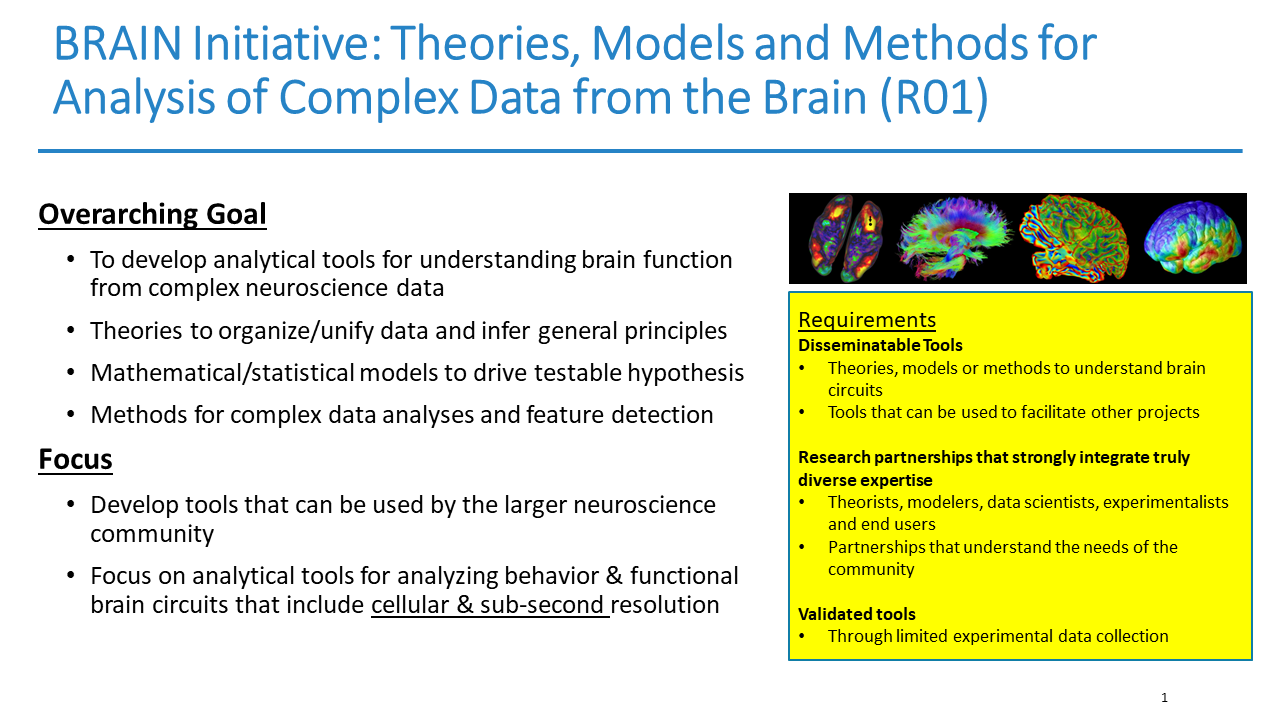
This wiki supports the activities of the NIH BRAIN Theories, Models and Methods grantees.
Working Group Leads
Bill Lytton, Fidel Santamaria
PI: HOWARD, MARC W
Email: marc777@bu.edu
Institution: BOSTON UNIVERSITY (CHARLES RIVER CAMPUS)
Title: Toward a Theory for Macroscopic Neural Computation Based on Laplace Transform
PI: NEMENMAN, ILYA M
Email: ilya.nemenman@emory.edu
Institution: EMORY UNIVERSITY
Multiple PI: SOBER, SAMUEL
Title: Neural mechanisms and behavioral consequences of non-Gaussian likelihoods in sensorimotor learning
February 14, 2020 Conference Call, 3-4pm ET
MINUTES
1. Introductions
Attendees:
The TSR is a communication tool for modelers to organize their model development process and present it coherently to each stakeholder's interests